A First Park Run: A Low-Fuss Plan for Finding Your Bearings
A first park run feels easier when you know where to meet, what to bring and when to arrive, with a calm plan for the small snags along the way.
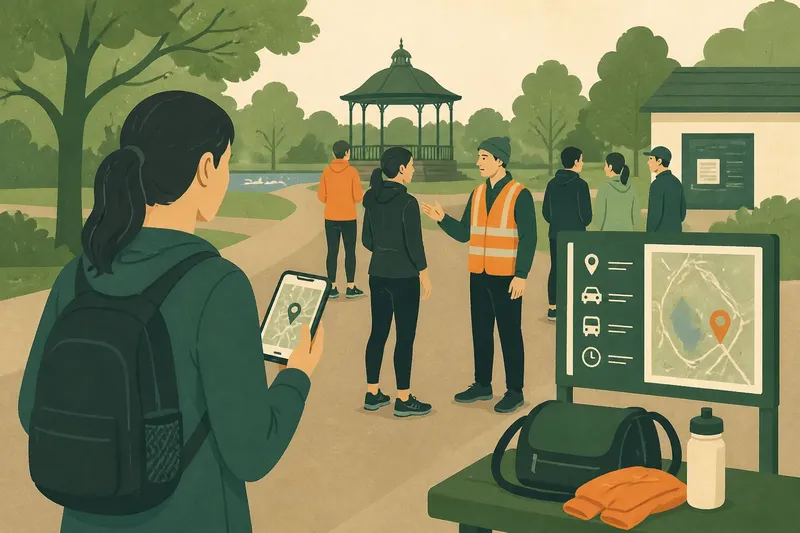
Where do you go, and what if you turn up at the wrong entrance? A first park run is easier when you plan for the small points of uncertainty: the meeting place, the route in, the start area and the moment you need to ask someone for help. You do not need to master the event in advance; you need a few clear decisions that leave room to settle in.
Park events differ in how they organise arrivals, starts and facilities, so check the event’s own page or recent notice before setting off. The plan below is about finding your bearings at an unfamiliar venue, not about running a particular distance or pace.
Meeting point confusion
What goes wrong: “At the park entrance” sounds clear until a park has several gates, car parks or paths. A map pin may point to the centre of the park rather than the event’s gathering place, and a landmark can look different when you are approaching from the other side.
Why it happens: Event descriptions often assume that regulars already know where to assemble. A start area may be beside a pavilion, café, noticeboard or broad path, while the nearest entrance is somewhere else.
What to try: Look for a named meeting point in the event information and check it against a map. If the notice names a feature such as a bandstand or visitor centre, search for that feature rather than relying on a dropped pin alone. Check whether the event directs people to a particular gate or car park.
Save the event page and the location on your phone before leaving home. If the map shows several plausible approaches, choose one and note a recognisable landmark near the meeting point. That gives you a useful reference if mobile reception is patchy.
Say you find an event notice that says to gather near the boating lake, but the map shows two paths leading to it. You could choose the path from the named car park, save the lake as a destination and check the noticeboard once there; the expected result is a clear route from arrival to the gathering area, rather than a search across the park.
If the meeting place remains unclear, use the event’s stated contact channel before the day. A short question about the exact landmark is more helpful than guessing at the gate.
Travel uncertainty
What goes wrong: You reach the right park but discover that your chosen entrance is closed, parking is full, or a bus stop leaves you farther from the event than expected. The venue may also have paths that are less direct than they look on a road map.
Why it happens: A route planner usually takes you to a postcode, road or car park, not necessarily to the event gathering point. Park access can depend on the entrance you choose, and weekend services or parking arrangements may differ from a familiar weekday journey.
What to try: Check the final stretch as carefully as the main journey. Find the likely entrance, identify a back-up approach, and look for any event notice about parking, public transport or access restrictions. If you are using a bus or train, check the onward walk and the service home as well as the outward trip.
Keep the back-up simple: a second entrance, a nearby public transport stop or another lawful place to leave your car. Do not rely on a shortcut through a locked gate or an unmarked track.
If your route depends on a ticket, a parking rule or a facility’s opening hours, check the current provider or venue information; local arrangements can change.
Arrival timing
What goes wrong: Arrive too close to the start and every small delay feels urgent. Arrive much earlier than you need to, and you may spend a long time waiting without knowing where to stand or what to do.
Why it happens: A first visit includes tasks that regular attendees do automatically: finding the gathering area, reading notices, locating toilets and working out how the start is organised. The event’s advertised start time may not describe when newcomers should arrive.
What to try: Choose an arrival window that gives you time to walk from your entrance, look around and ask a question without rushing. Check the event’s guidance on registration or briefing, if it has one, and build your arrival around that rather than assuming you can turn up at the last moment.
Plan a comfortable buffer, not an elaborate timetable. If you are travelling by public transport, leave room for an ordinary delay; if you are driving, allow time to park and walk in. The right window is the one that lets you arrive composed while still keeping the wait manageable.
Unclear event routine
What goes wrong: You see people gathering but cannot tell whether they are waiting for instructions, chatting before the start or queuing for something. It can feel awkward to join in when everyone else seems to know the routine.
Why it happens: Community running events often have informal habits alongside their posted information. Regulars may recognise the organiser, know where to gather or understand a brief announcement without needing a sign.
What to try: Look for an organiser, volunteer or event noticeboard and ask a direct question: “Is this the right place for a first visit?” or “Where should I wait for the start?” A clear, ordinary question is usually enough to get oriented. If the answer is not clear, ask another identifiable volunteer rather than following a crowd towards an uncertain route.
Listen for any briefing and follow the instructions given to participants. If you arrive after the main group has moved, do not assume you should set off alone; find an organiser and ask whether joining is still appropriate.
Small kit snags
What goes wrong: You arrive with a bag but do not know where to leave it, have no easy way to carry a layer, or realise you have brought items you do not need. A first visit can tempt you to pack for every possibility.
Why it happens: An unfamiliar venue makes simple choices feel uncertain. You may not know whether there are lockers, a staffed place for belongings or a sheltered waiting area, and you do not want to be caught without something useful.
What to try: Check the event information for facilities, but plan to keep valuables with you unless the organiser clearly describes a secure option. Bring only what suits your journey and the conditions: for example, a light layer that can be tied or carried, a small water bottle if you prefer one, and a way to keep your phone accessible.
Choose familiar running clothes and footwear rather than using the event as a reason to try unfamiliar kit. For a first visit, comfort and easy movement matter more than having a perfect-looking outfit.
When should you ask for help?
What if I cannot find the start?
Pause at a recognisable landmark and check the saved event information before wandering farther into the park. If the location still does not make sense, contact the organiser using the event’s stated channel or ask a volunteer in an event-branded top.
What if I arrive after the briefing?
Find an organiser and explain that it is your first visit and you may have missed the instructions. Ask whether you can still join and where to go; do not set off based only on seeing other people running.
What if I feel unsure about the route?
Ask how the course is marked and what to do if you lose sight of the people ahead. If you cannot understand the answer or the route appears to differ from the event information, wait for clarification rather than guessing at a junction.
What if I need a quieter start?
Tell an organiser that you are new and would like a moment to understand where to stand. You can choose a place that feels comfortable and follow the event’s start instructions without needing to explain more than you wish.
A simple arrival sequence
Keep the preparation in this order so you are not trying to solve every detail at once:
- Check the event’s current information for the meeting place, arrival guidance and any access notes.
- Match the named landmark to a map, then save the location and a suitable entrance.
- Check your journey to the park and choose one straightforward back-up route.
- Pack familiar essentials and confirm what the event says about belongings and facilities.
- Choose an arrival window that leaves time to walk in, look around and ask a question.
- On arrival, confirm the gathering place with an organiser or volunteer before joining the routine.
Each item answers a different source of uncertainty. There is no need to keep refreshing maps once you have a clear entrance and meeting point; save the information and let the plan do its job.
Make room to settle
A first park run is not a test of how quickly you can decode an unfamiliar place. The useful preparation is modest: know the landmark, understand your route in, carry only what you need and leave enough time to ask for help without feeling hurried.
For a first park run, a saved meeting point and a comfortable arrival window are often more useful than a tightly packed schedule. Once you have found the gathering area, take a moment to notice the paths, facilities and people who can answer questions. That small pause helps the venue feel like a place you can return to, not a puzzle you had to solve once.