Before the Starting Gun: How Race Starts Took Shape
Race starts took shape through local customs and clearer signals; learn how today’s start-line rituals help runners know where to stand and when to go.
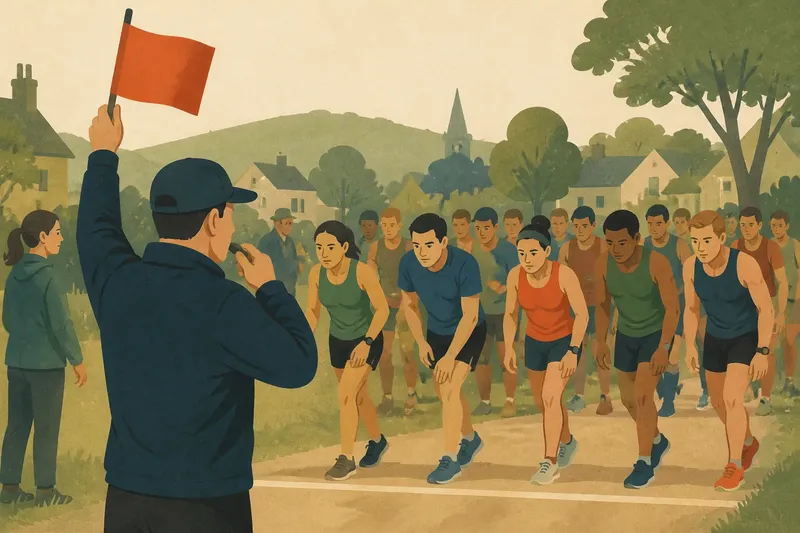
At a village race, a volunteer raises a hand, waits for the chatter to ease and calls, “Ready?” Runners shuffle into place, someone nods, and the group sets off. Race starts took shape through practical signals at local gatherings, then became rituals that help strangers begin together.
The history is not a simple shift from casual to formal. Communities adapted starts to the size of a gathering, the ground beneath runners’ feet and the need for everyone to understand when to move. A starting gun became one recognisable cue among several, not the whole story.
Gathering before the signal
Local races have often used whatever space was available: a village green, a road outside a public house or the edge of a field. In Britain, pedestrian contests were part of popular sporting culture by the eighteenth century, including professional foot races promoted through public challenges and wagers. These contests were not all organised alike, so there was no single starting custom that every community followed.
In a small gathering, a spoken call, raised flag or bell could be enough. Runners and spectators were close to the organiser, and a late arrival could ask where to stand. That kind of arrangement suited a familiar setting, but it depended on people being able to see or hear the cue.
As fields and crowds grew, one quiet voice or gesture became less useful. The practical problem was not simply how to make racing look formal; it was how to make the same signal reach runners spread across a line.
Signals that travel
A gunshot provides a sharp audible cue, which helps explain its place in organised racing. It can carry beyond the immediate line, unlike a quiet spoken instruction. A whistle, bell, horn, flag or clear verbal call may suit a smaller event better, depending on the setting and who needs to receive the signal.
Organisers can also make the cue easier to understand by giving it a sequence. A call to move into position, a pause for quiet and a visible gesture prepare runners for the signal, so it marks a shared instant instead of interrupting a crowd that is still settling.
Say you are organising a neighbourhood race with runners spread along a narrow park path. You ask everyone to gather behind a painted line, raise a bright flag and sound a whistle only when the path ahead is clear. The expected result is that runners near the front and back can recognise the cue, while the group waits rather than crowding the route.
From line to ritual
Start-line customs carry practical information as well as atmosphere. A brief welcome can explain where to wait, which way the course turns and what to do if someone needs to step aside. A countdown or shared cheer gives the group a familiar rhythm before movement begins.
These gestures also make a race feel like an occasion. Runners who have trained alone suddenly stand among others with the same immediate task: listen, watch, then go. A small ceremony marks that change without requiring everyone to know one another.
Start-line rituals vary with place and scale. A large city event may use barriers, loudspeakers and separate waves; a small club race may rely on a marshal’s voice and a flag. Neither is inherently more authentic. Each works when its signals suit the setting and participants can tell what is happening.
What makes a start clear?
Why do races use a countdown?
A countdown gives runners a shared cue that the signal is close, reducing the chance that people move at different times. It also brings order to the final moments without adding complicated instructions.
Does every race need a gun?
No. A gun is one way to make a start audible, but a whistle, horn, bell or spoken call can suit a local event. The signal needs to be clear to the runners present and appropriate to the venue.
Why are runners sometimes sent off in waves?
Wave starts divide a large field into smaller groups, helping prevent the line from becoming too dense at once. They can also make instructions easier to hear and give runners room to settle into the course.
What should a first-time runner watch for?
Look for the start line, listen to the organiser or marshals, and notice whether the event uses a countdown, flag or another cue. If instructions are unclear, ask before moving into position rather than trying to infer the signal from the crowd.
A calmer race morning
Race starts took shape as communities found ways to turn a gathering into a clear departure. A runner does not need to know every tradition to take part, but understanding the sequence can make the first moments feel less mysterious.
- On arrival: Check where runners are asked to wait. If a marked holding area is visible, use it; if not, ask a marshal rather than standing on the course.
- Before lining up: Listen for instructions about waves or course direction. If your group is named, join it; if you are unsure, confirm with an organiser before moving forwards.
- As the group gathers: Look for space that lets others line up too. If the front is crowded, stand further back; if there is room in your assigned area, move into it without pushing past runners.
- Just before the cue: Watch the organiser or marshal. If you can see the signal, follow it; if you cannot, wait for a clear audible cue rather than moving because nearby runners have started.
- If the start is delayed: Stay clear of the route and listen for an update. If the organiser gives a new time or instruction, follow it; if nothing is clear, ask a marshal instead of guessing.
- After the signal: Begin at a controlled pace. If the path is crowded, leave space and settle in behind others; if it is open, move forwards without cutting across the field.
At your next race, the phrase “race starts took shape” can mean more than a story about old signals: it points to a shared practical task. Find the line, listen for the cue and give the people around you room to begin; a clear start is built by the organiser and the runners together.