Why a Loop Route Feels Different from an Out-and-Back
A loop route changes how a run feels by giving the return fresh scenery, a new sense of progress and different cues for managing your pace.
Why does a loop route feel different from an out-and-back, even when both take you through familiar streets? A loop route gives the return journey its own scenery, so progress is marked by places you have not just passed in reverse. That small change can alter how the outing unfolds, from the first push away from home to the final turn.
Two shapes, two rhythms
An out-and-back follows one path in both directions: you run to a chosen point, turn around and retrace your way. A loop brings you back to your starting area by another stretch. The route may circle a park, link several streets or follow a waterside path before turning inland.
On an out-and-back, the turnaround is easy to understand. You reach the point you chose, then travel home along ground you recognise. On a loop, there may be several small landmarks along the way, but no single moment says “halfway” unless you decide one should.
Neither shape is automatically easier. Their difference lies in how they divide attention: repetition makes an out-and-back legible, while changing scenery gives a loop a sequence of fresh sections.
Fresh scenery on return
Retracing a path makes familiar details appear from the opposite direction. A shop that faced you on the way out may be behind your shoulder on the way back; a hill you descended becomes a climb. You know what is coming, but it does not look quite the same.
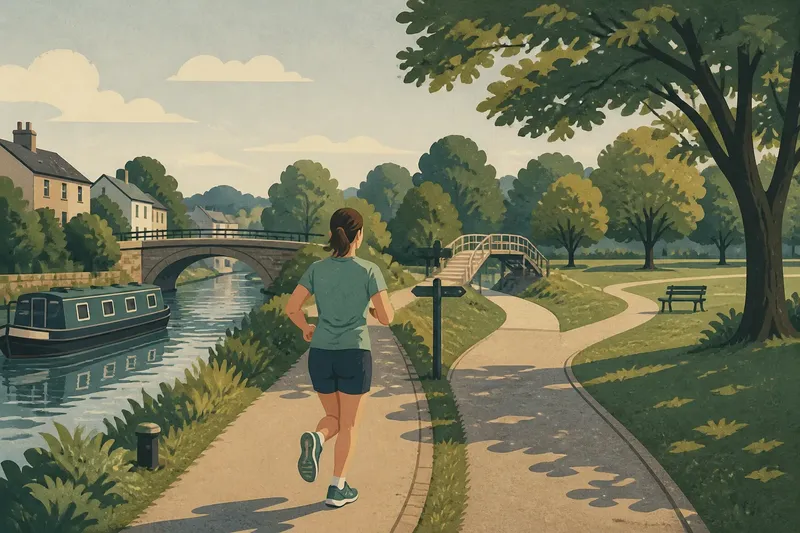
A loop removes that reversal. Instead of seeing the same bridge twice from opposite sides, you might cross it once and return along a lane beside the park. Each change in setting can give the run a clear chapter: pavement, shaded path, open field, then quiet residential streets.
That novelty need not be dramatic. A different pavement, a row of trees or a view across a playing field can be enough to make the return feel like a new part of the outing rather than a replay.
How progress registers
An out-and-back offers an obvious marker: the turn. Before it, you are moving away from your start; afterwards, you are heading home. That simple structure can be reassuring when your attention is drifting, because the next task is clear.
A loop asks you to notice progress in smaller cues. Perhaps the canal path gives way to a footbridge, or the busy road becomes a quiet terrace. Those transitions tell you that the route is advancing even when the start is not yet in sight.
Imagine you set out from a library, run along the canal and return through a residential park. At the bridge, you turn towards the park rather than retracing the towpath; seeing the library roof appear beyond a familiar row of trees can make the route feel as if it is closing naturally, not simply repeating itself.
That sense of arrival is partly about anticipation. On a loop, you may recognise the final streets only near the end, while an out-and-back lets you watch the homeward approach unfold from the turning point.
Pacing without repetition
Known terrain can make pacing feel straightforward. On an out-and-back, you may remember where the path rises or where the pavement narrows, then use those cues again on the return. The repetition also makes it easier to compare how a section feels in each direction, without treating that impression as a verdict on the whole run.
A loop changes the cues as well as the scenery. A sheltered path may invite an easy, steady rhythm, then an exposed stretch may make you more aware of wind or effort. Rather than expecting every part to feel alike, let the route’s surfaces and turns shape your attention.
For a relaxed run, choose a pace you can adjust rather than trying to hold one sensation throughout. If a loop includes a hill on its later section, it can help to begin gently and meet that climb with room to respond.
Choosing a route shape
Pick an out-and-back when you want a clear turning point, an easy route to shorten, or a familiar stretch that helps you settle into the run. It can also suit a path where the safest or most pleasant option is simply to return the way you came.
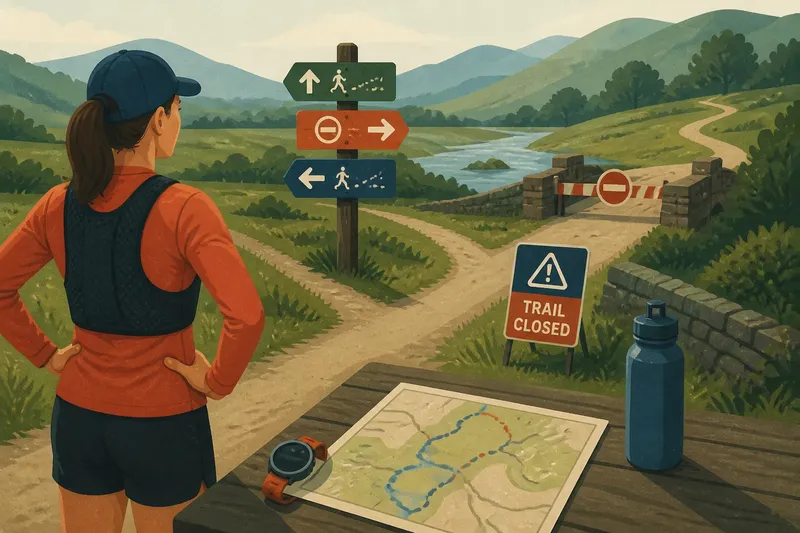
Choose a loop when varied surroundings keep you engaged or you would rather not cover the same ground twice. Before setting off, check that the connecting paths are open and that the route has a sensible way back to your starting area. A map app can help you see whether a promising loop actually links up.
Local access rules and path conditions can change, so follow signs and use the route information provided by the land manager where available. A route that looks connected on a map may include a gate, a muddy section or a stretch that is less comfortable after dark.
Questions runners ask
Is a loop route harder?
Not by shape alone: effort depends on the terrain, surface and conditions, as well as how you choose to run it. A loop can feel more varied, while an out-and-back can make the return leg feel familiar.
Which route is easier to shorten?
An out-and-back often has a simple option: turn around earlier and retrace the path. A loop may have a shortcut, but it is best to identify a safe, accessible connection before you rely on it.
Why can the return feel quicker on a loop?
New landmarks can make the journey seem to move in distinct stages, so attention is less fixed on how much ground remains. That is a change in perception, not a promise that the route or effort is shorter.
Should I run both route types at the same pace?
You can use a similar easy effort on either, but terrain and conditions may call for adjustments. Let conversation, breathing and comfort guide the run rather than assuming every section should feel identical.
Let the shape work
A loop route is most satisfying when its changing scenery has a purpose: each stretch leads naturally into the next, and the final approach feels like part of the outing rather than a search for home. An out-and-back offers a different pleasure, with the turning point and familiar return making progress easy to read.
When choosing your next loop route, look for one distinctive change of scene on the way home, not a complicated detour. A quiet lane after a riverside path may be all it takes to make the return feel like its own part of the run.